

Beacon is a well-regarded CRM built specifically for charities. It's clean, it's well-supported, and a lot of organisations love it. So if you're weighing up Beacon against Makerble, that's a fair comparison to want to make; they serve a similar audience and there's genuine overlap. But there are some important differences that are worth understanding before you decide.
What Beacon does well
Beacon's strongest suit is fundraising. It's built around the supporter journey: managing donations, Gift Aid, memberships, legacies and event ticketing. If your organisation's primary challenge is managing donor relationships and income streams, Beacon is a strong, purpose-built option with a genuinely polished interface. Their customer support is highly rated, and their onboarding process is well-structured.
They've also invested in AI features to help with donor communication and data filtering, and they have a data warehousing option for organisations that want to connect business intelligence tools and run SQL queries against their data.
Where the two platforms differ
The orientation of the CRM
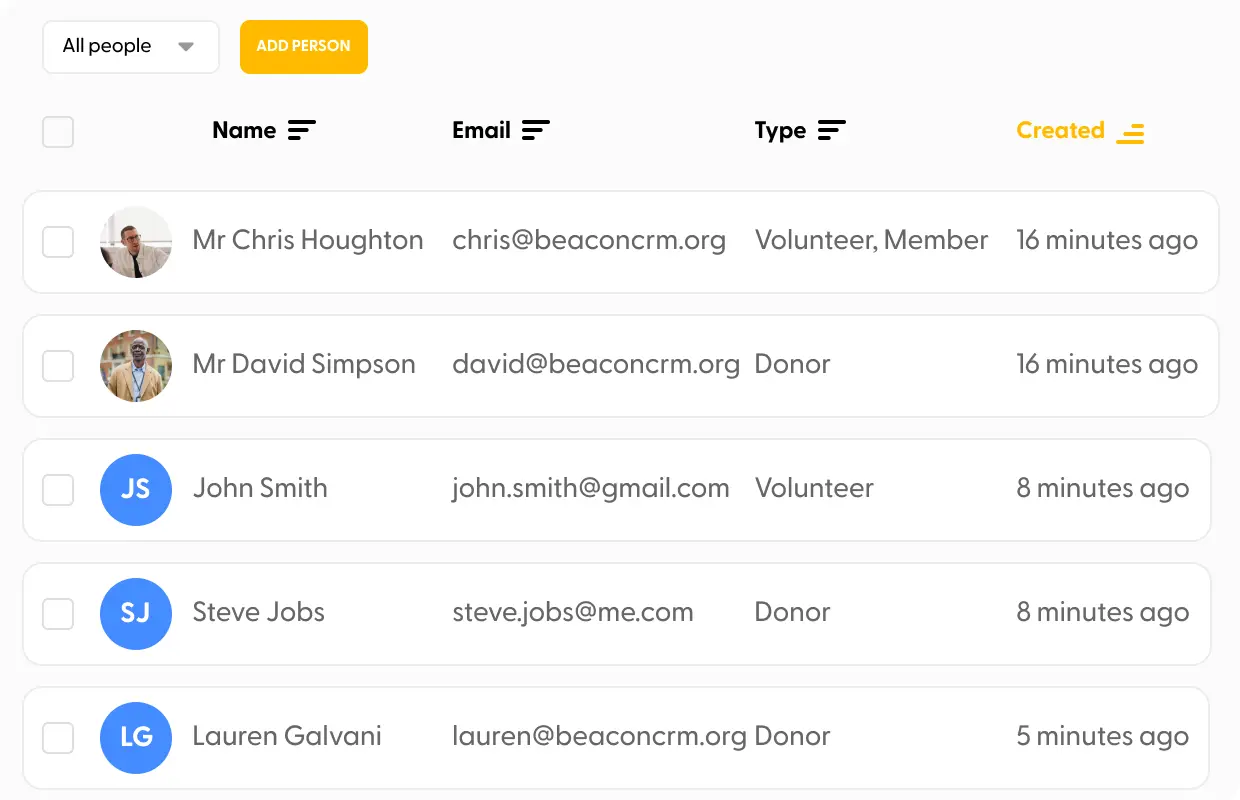
Beacon is oriented around supporters and donors. The contact record is built around the fundraising relationship- giving history, communications, Gift Aid status, memberships. That's exactly what a fundraising team needs.
Makerble's CRM is oriented around participants and outcomes. The contact record is built for organisations that work directly with people; tracking case notes, assessments, progress over time, referrals and service history.
Both are CRMs, but they're answering different questions. Beacon asks: who are our supporters and how much have they given? Makerble asks: who are we working with and what difference are we making?
If your team includes caseworkers, programme coordinators or service delivery staff, rather than only containing fundraisers, Makerble is more likely to reflect the way you actually work. The video below shows how a programmes team member might use Makerble day to day.
Surveys and outcome measurement
This is the sharpest difference between the two platforms. Beacon doesn't include a built-in surveys tool. If you want to collect feedback from beneficiaries, track wellbeing scores over time or run pre-and-post assessments, you'd need to integrate a separate tool like Typeform or SurveyMonkey and find a way to connect the responses back to contact records.
Makerble has a fully integrated surveys platform. You can deploy surveys directly to contacts in your CRM, collect responses over multiple time points, and analyse how scores change across a programme. The responses live against the contact's profile, so you can see a participant's journey; not just a collection of anonymous form submissions. Features like skip logic, conditional logic, question randomisation, multi-version surveys and reusable question libraries are all built in.
This matters a great deal for organisations that need to demonstrate impact to funders. The ability to show longitudinal change - e.g. that a cohort's confidence, skills or wellbeing improved over the course of a programme - requires survey responses to be linked over time. That's something Makerble is designed to do natively; it's something Beacon would require additional tools and manual workarounds to achieve.
Impact reporting
Beacon has reporting features, and with their data warehousing option, technically sophisticated teams can build detailed views of their data. But the impact reporting experience on Beacon is primarily built around fundraising metrics; income by campaign, donor retention, Gift Aid recovery and so on.
Makerble's impact reporting is built around outcomes. You can set up custom KPIs, track Theories of Change, build logic models, create Outcome Rings and produce funder-ready dashboards that show what's changed for the people you work with. The ImpactStore™ library also gives you ready-made outcome frameworks and indicator sets that you can apply to your projects in a few clicks.
Scheduling
Beacon handles event ticketing, which works well for fundraising events and one-off occasions. Makerble's scheduling module goes further for programme delivery:, covering recurring group sessions, individual appointments, attendance registers, staff rotas and timesheets. If you're running classes, workshops, drop-ins or a caseload of one-to-one appointments, Makerble's scheduling tools are built for that operational reality.
Pricing
Beacon's pricing starts at £33.50/month for their Starter plan (up to 2,000 contacts, 3 users), rising to £114/month for Standard and £292/month for Premium. There's a free trial to explore the platform, but no permanent free tier. Once the trial ends, you're on a paid plan or you're out.
Makerble offers a free tier that you can use indefinitely. That makes it genuinely accessible to smaller organisations, early-stage projects or teams that want to get set up and start collecting data before a budget decision is made. Paid plans unlock additional capacity and features as you grow.
For organisations operating on tight budgets, which usually describes most charities and voluntary sector bodies, the ability to start for free and upgrade when you're ready is a meaningful difference. It also means there's no pressure to rush an onboarding decision: you can take the time to build your forms, set up your surveys and get comfortable with the platform before any money changes hands.
Who should choose Beacon?
If the heart of your operation is fundraising i.e. managing donors, processing donations, running appeals, tracking Gift Aid and cultivating supporter relationships, then Beacon is an excellent, well-supported choice. It's particularly strong for charities where income generation is the primary pressure on the team.
Who should choose Makerble?
If you're a charity, social enterprise or voluntary organisation whose work centres on delivering services to people, measuring the difference you make, and reporting outcomes to commissioners or funders, Makerble is built for that. It brings together CRM, surveys, scheduling and impact reporting in a single platform, so that the data you collect through day-to-day delivery automatically feeds your reporting, rather than sitting in a separate system that needs exporting, cleaning and reconciling.
Many organisations find that they need both fundraising capability and service delivery capability. If that's you, it's worth having a conversation with both teams to see how each platform handles the full picture.
A note on the two approaches
Beacon's tagline is “Transform how your charity works.” That framing is mostly about operational efficiency and usability - making the admin side of running a charity less painful.
Makerble's focus is on helping organisations understand and communicate the impact they create. The platform is designed so that the act of managing your work automatically generates the evidence you need to prove it's working.
Those are compatible goals, but they're different starting points and it's worth knowing which problem you're most urgently trying to solve.
To find out more about how Makerble supports data collection, programme management, reporting and impact measurement for NGOs, book a demo or explore the platform.





.png)

%208.png)


.png)


